Friday, September 18, 2026

RECIPES FROM THE WINKING KAT KITCHEN

 Recipes from the Winking Kat Kitchen

From Treasure Island: Ben Gunn's Welsh Rarebit


In Robert Louis Stevenson's adventure tale, "Treasure Island", the character, Ben Gunn, says what he's missed most while being stranded on treasure island for three years was eating melted cheese on toast. 

In honor of Ben Gunn, we'd like to share this recipe for Welsh Rarebit (melted cheese on barley toast)

(in photo: Welsh Rarebit with pear slices)


Recipe for the Barley Bread

(recipe adapted from one posted by Linda Whitworth from Alberta, Canada)

INGREDIENTS:
  • 2 cups water-heated to @108 degrees F
    • (about 450 ml)
  • 1 1/2 Tbsp. (22 ml) Honey or
    • 1 1/2 Tbsp sugar (@ 24 grams)
  • 1 Tbsp (7- 8 grams) yeast
  • 1 1/4 cups (150 grams) barley flour
  • 3 cups (360 grams) all purpose flour
  • 1 Tbsp (8 grams) Bob’s Red Mill Gluten Flour
  • 1 Tbsp + 2 1/2 tsp (22 ml) vegetable oil
  • 1 Tbsp + 2 tsp (20 ml) lemon juice
  • 1 1/2 tsp salt
** One difficult thing is finding good barley flour. Fairhaven Mill in Burlington, WA is one good source for freshly milled barley flour from local farmers.

Baking the Bread (produces 2 loaves)

Pour heated water into a medium to large bowl. Dissolve honey or sugar into the water. Sprinkle the yeast over the top (stir lightly).

Let the yeast sit for about 10 minutes until frothy.

Then add the barley and all purpose flours, gluten flour, oil, lemon juice, and salt. Mix with a bread hook attachment on you mixer or mix by hand. Kneading by hand is often best to make sure you don’t over work the dough. Lightly flour a flat surface. Turn out the dough on the surface and begin kneading – adding flour if necessary to get a good texture. Look for strands of gluten in your dough. When you see good gluten strands, oil a clean bowl and set the dough in the bowl for the first rise. Cover the bowl with a damp tea towel and let sit in a warm, still place for about 30 minutes.

Dough should be about double in size. Prepare your bread pans by spraying VERY lightly with vegetable oil spray. Turn the dough back onto the flat surface and knead again for a few turns. Divide the dough if necessary to roll and fit into loaf pan(s). The roll should be the length of the pan and about half the height. Cover again and let sit for a second rise of about 45 – 60 minutes or until doubled in size.
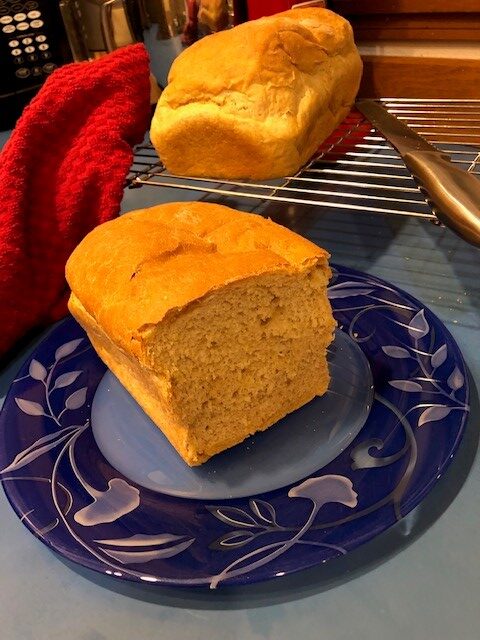
Heat oven to 375 degrees F (190 C). When dough & oven are ready, place the bread pans in the center of the oven & bake for about 25 minutes or until light golden brown on top. Bread should sound hollow when tapped. Let cool.

(two finished loaves)


Recipe for the Cheese Sauce      
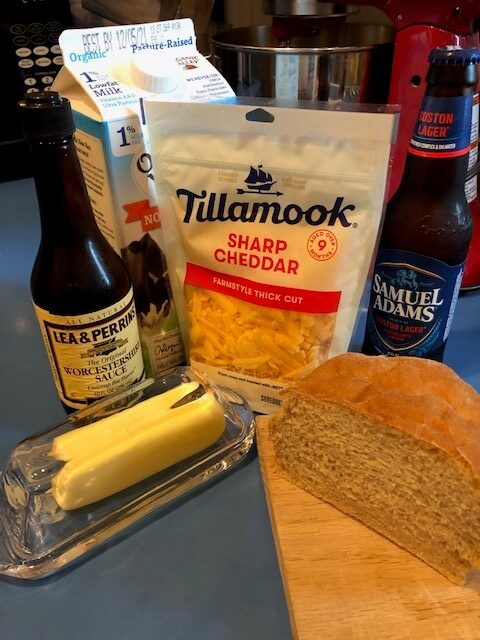
  • 2 Tbsp butter
  • 2 Tbsp flour
  • 1/4 tsp salt
  • a pinch of pepper
  • 1/4 tsp dry mustard
  • 1/4 tsp smoked Paprika
  • 1/2 tsp Worchestershire sauce
  • 1/2 cup whole milk
  • 1/4 cup beer
  • 3/4 cup shredded Cheddar cheese
  • 1 drop Tabasco sauce (if desired)
Cooking steps

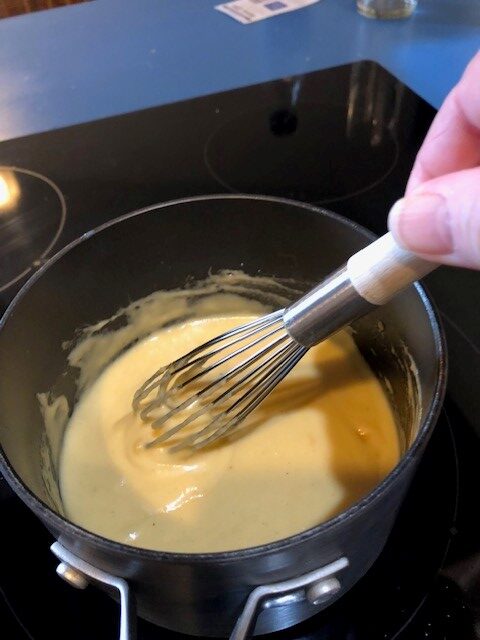
In a small saucepan, melt the butter over medium-low heat. Be careful not to burn. Whisk in the flour, salt, pepper, mustard, paprika, and Worchestershire sauce. Keep whisking until the mixture is smooth with no lumps.

Take the pan off the heat and whisk in the milk slowly. When the milk is incorporated into the butter/flour mixture, return the pan to the heat and bring the milk to a boil while continually stirring. Keep stirring and add the beer. NOTE: The alcohol will evaporate but you can use non-alcoholic beer if you have any concerns. Cook about one more minute than add the shredded cheese a little at a time while continuing to stir. When all the cheese is melted into the mixture, remove it from the heat.
Lightly toast slices of the barley bread and set on your plates. Pour the warm cheese sauce generously over the toasted bread and serve.

YUM. Ben Gunn would be soooo happy.


Sunday, November 18, 2012

A Guaranteed Happy Ending

photo by Tim Poltevin and Second Story Repertory.

Taking the trail one step at a time.
It was a crazy summer with family activities and amazing changes, but I am so excited to have so many wonderful things happening.  The recording we made of the songs from "The Dancing Princess" turned out great and I am putting the final touches on a novelized version of the story.

A discussion of the current status of theatre for children in this country has led me to wonder if many theatre companies even consider producing shows that are not already based on a popular book.  I discussed the trend with Linda Hartzell of the Seattle Children's Theatre and Mark Chenovick of Second Story Repertory.  One of the problems of doing something original is that parents and teachers are hesitant about taking their children to a performance when they aren't certain of the content or the ending of the story.  It's sad but true that we all want to know what's going to happen before we see it.  So many parents are afraid there might be something unexpected.  

Mark Chenovick took a risk presenting 'The Dancing Princess'.  It was not a well-known story, although loosely based on "The Twelve Dancing Princesses".  But it wound up being one of their most successful productions of last season.  Maybe the trend is turning and parents as well as children are willing to take the risk of seeing something without first securing a guarantee of the outcome.

Here is Emily Shuel singing one of my favorite songs from the show, "Yulia's Lullaby".


Saturday, May 19, 2012

Where there's a will, there's a way

The Great Wall of China

Where there's a will,

There's a way.

 When I was a kid, my parents didn't have a lot of money - especially for your basic white, middle-class, Americans.  We weren't living out of our car, but there were many days when I had oatmeal for breakfast as well as dinner and had one pair of school shoes and one pair of sneakers to my name that were supposed to last for two years.  Luckily, I liked oatmeal and I pretty much reached my full height and shoe size at age 13 so the shoes were able to last the two years.

It was kind of frustrating for me, however, because I was a kid with big dreams.  It didn't help that most of my friends came from wealthy families.  They had pools in their back yards and went to Switzerland on vacation while I used the rafters of our unfinished basement as monkey bars and floated on inner tubes down the muddy creek behind our home.  My father used to tell me, 'where there's a will, there's a way.  If you really want something, you will find a way to get it.'  He wasn't talking about anything illegal, of course.  He was talking about thinking outside the box to find a creative way to achieve your dreams.  In school, we studied amazing feats of achievement like 'The Great Wall of China" and the pyramids of Egypt and I learned that seemingly impossible things can happen with planning, patience, and sheer will.

 If human beings could do amazing things like that maybe I could accomplish some of my dreams.  After all, I didn't exactly want to build a 500-foot-tall monument to myself.  I wanted simple things.  For example, we had an amusement park down the road from my house.  I could never afford to go there except when they had 'Report Card Day' where they gave away tickets for good grades.  So when I turned 13, I applied to work there.  I got a job attaching strings to people's wrists for special events and later, at age 17, I was able to operate some of the rides.  The hours were long, but I was surrounded by the sounds and sites of the park and on rainy days when things were slow, I got free rides on the merry-go-round.  

I'd always wanted to work in show business.  Although I was ridiculously obnoxious as a young child, I became very shy as a teenager.  Way to shy to try out for school plays or choir.  The force was strong within me, however (yes, I went there) and it pushed me to search for other ways to get involved.  I looked for ways to work backstage and continued to do so after I graduated from college.  Every chance I could, I worked for free to learn more about every aspect  of television and theatre.  I interned at a television station for minimum wage to help pay for college.  I stage managed community theatre productions - one after the other.  After a while, I realized the people on stage were just as nervous and anxious as I was about performing and I tried it.  Soon I was singing and dancing all over the place.  Another check off my proverbial bucket list.  

 I'd always wanted to travel, so with a little money saved up, I applied for some post-graduate work at a school 3000 miles from my home, packed my VW Baja Superbeetle and left for the West Coast.   I wound up not attending the school but found a cool job working with a design firm and building a life here in Washington State.  Check.  Started my own successful business with money I borrowed on my credit card.  Check.  Sold that, then started two more.  Check. And check.   All the while I was able to continue to do some work in theatre and films and writing stories, ( http://theponymanmovie.com/cast.html )and (http://winkingkatbooks.com/).  Double check.

I didn't mean for this blog entry to wind up so autobiographical, but I wanted to illustrate that the advice my father wound up to be true.  I've checked off so many things on my 'to do' list of life by just finding some way, any way, to make them happen without money or connections. Though it often meant entering through the back door, I still got into the house.  Now that I'm older and hopefully wiser, I know that I may never realize the grandiose dreams of my youth (unless I live another fifty years) but in small, satisfying ways I've seen most of them granted.  Thanks for the advice, Dad.

Wednesday, May 2, 2012

Authenticity or Not

Authenticity or NOT? 

or Am I being too anal about this?  

I've had many jobs in my life and could say a couple careers.  I still divide my time between art and theatre and have been lucky to earn money at both.  As an actor, I can tell you (and most other actors will agree) one of the most annoying and frightening parts of the job is the audition process.

 
 Auditions are kind of a mixed blessing.  You are 'Oh, so glad' you have them, but at the same time, wish you were going to a session of waterboarding instead.  The big problem is that you are usually unsure of what the expectations of the producers and directors of a show will be.  How do you plan for the unknown?  Sometimes, you're lucky and on the mark, everything goes well, there are smiles all around, and you have a good shot at the role.  Other times you get the feeling when you pull out your tap shoes and everyone else in the green room has ballet slippers and ballerina buns that you have totally misinterpreted the concept the production is looking for.  That's when the directors watch your audition with that look of bewilderment and a fixed smile and you know the minute you walk into the room that you're screwed.

I have an audition this weekend for a period piece.  The story takes place in medieval times.  The script is not badly written and in the right hands it could be a very cool project.  (This is actor speak for "I genuinely hope I get the part").  There is one problem.  I'm not sure at the present time whether they will be looking for someone who can do the role with an appropriate dialect or if they are planning to do this in pseudo historic times where everyone talks like they came out of the local Wendy's with a couple of 'thy's and 'm'lord's thrown in.  I could ask them ahead of time via email, but I've already asked a different question and I don't want to appear to be a pain before they even meet me.  Actors hate to be labeled a 'problem actor' before they even show up at an audition.  


So I will have to wait and ask them right before my audition and be prepared for both.  I hope they do want some type of dialect.  One, I know if they do I can nail it.  Two, I really hate to watch films and television where the story takes place in another time or in 'generic fantasy land' and all the characters sound like they came from LA Central Casting.  It really takes away some of the magic.  Maybe I'm being to anal or picky, and I don't expect actors to be too authentic.  In the case of the Renaissance or the Middle Ages, if you were too authentic, everyone would need subtitles to understand what the actors are talking about.  

One example that drives me crazy is the new TV series, "Once Upon A Time".  I basically like the cleverness of the plot and the acting isn't bad, but other than a more dramatic hairstyles and costumes, the characters in fairytale land look and sound like they just stepped out of the Valley Galleria.  It may be intentional, but it really takes away from the story for me.  I know there are other examples in film and TV as well.  

So, I'll be ready with my generic, middle-ages, European dialects -French, Irish, or British (if they ask for German or something else, I'd be astonished and impressed), but will ask first.  Otherwise, I'll see that bewildered, fixed smile on the director's face and I'll know I totally screwed the audition.

Tuesday, April 10, 2012

Unlocking Creativity

UNLOCKING CREATIVITY

Okay.  I am working on a new play for our summer touring season of shows for young audiences.  I'm on schedule with the deadline I have set for myself of May 1st to finish the play.  That way our actors have enough time to rehearse the show before our first performance in June.  About one-third of the way into the play, I hit a roadblock or should I say 'writer's block'.  A song, or what I hoped to be a song.  It is a common problem with writing this type of play for children.  The song has to be short, fun, witty, catchy, a little silly, but still has to impart some information and move the story forward.   I could have left it and come back to the lyrics later, but I find it difficult on the first draft to leave a block out of the story like that.  Silly, I know, but that's the way I write for better or worse.

I tried and tried to work the problem.  Dragged out information from Google, Wikipedia,  and rhyming dictionaries, but nothing was coming.  My brain was a dry well.  One day went by then two and I was still staring at the same page.  I knew what I wanted to happen after this section, but I couldn't go on without the connecting puzzle piece.  

While driving to an appointment on the second day I was listening to a radio talk show.  They were interviewing a man who had written a book on the nature of creativity in the brain.  He said creative people are average people who have an epiphany about something, can recognize it and respond to it.  I kind of knew that part.  Like many writers or artists I have a lot of epiphanies - usually in the middle of the night or in the shower unfortunately when I don't have a paper and pencil handy.  I have too many epiphanies.  They crowd my brain and keep me from having a decent, coherent conversation with anyone.  I knew about that.  But the gentleman on the radio had some other interesting facts about creativity.

He said scientists could tell when an epiphany is coming by the number of Alpha waves in the brain.  It seems epiphanies come when the impulse inhibitors of the brain are calmed or disabled and the Alpha waves take over.  The key is to relax.  Walk away from the problem.  Forget the deadlines and don't stress about it.  It seems counter to every lesson about perseverance and tenacity, but one can't argue with the EEG's.  The author on the radio suggested taking a small drink or using another similar relaxing substance.  Not wanting to turn into Earnest Hemmingway or Edgar Alan Poe, I didn't think using alcohol was a good option for me.  But the idea of going for a walk or taking a nap could work.  I do often get my best ideas when I'm half asleep.  This time, however, I'd have a pen and paper ready.  Sure enough while I was sleepily putting away the laundry my epiphany arrived.  I bolted downstairs and typed the lyrics into my computer before they had a chance to scatter among the other images and phrases caught in my brain's neuron whirlpool.

Lyrics recorded, I could finally move on to the next scene and the next sequence of the story.  I wish I could have caught the name of the gentleman they were interviewing. Whoever he is, I owe him many thanks for the relaxing hours ahead and their accompanying epiphanies. 

Saturday, March 10, 2012

Page to Stage: Birth by Committee

The Birth of a Dancing Princess

In 2000 I wrote an adaptation of the story, "The Twelve Dancing Princesses" to be performed by the touring theatre company I co-founded with Alexandra Clark.  We joked that we did not have the budget (or room in the touring car) for more than one princess, so that's what we had.  When I was doing the research on the story, I found Hans Christian Andersen might have actually based his story on a Ukrainian folktale that was very similar.  In turn that story might have been based on a Persian folktale and so on.  

I chose to set my play in Russia to follow the theme and flavor of the folktale.  Because I managed the touring company, I had a lot to say about the production which was very successful during its run in 2000 and also when we revived it in 2009.  It wasn't just successful, it was special.  Like any artist, a writer often can tell when one project has something special that makes it different or better than some of the other work they've done.  "The Dancing Princess" was one of those projects for me.  I was excited to meet and discuss the project with a friend and composer, Terry Levitt, who agreed to write the music necessary to expand the show.  The producers at Second Story Repertory in Redmond, Washington (a very cool theatre, by the way) patiently heard my pitch for the piece and agreed to produce it.  So the journey began.

Mark Chenovick, the executive director at Second Story, offered me the opportunity to direct.  I decided not to.  Although it might have been cool to follow through and see the piece through to production all with my own vision, I thought it would be more interesting to see what other directors and producers might see in it.

With the exception of a one-man or one-woman show, theatre is a magical art that requires a committee of people (or multiple committees) to make it happen.  I'd sat in my office chair for so many hours with the characters of "The Dancing Princess" dancing in my brain, I realized I totally needed to let them go to see how they would perform.  The directors, costumers, set and lighting designers all took the helm.  The actors brought their talents and knowledge and skills and the whole thing sprang into colorful, three-dimensional life while I watched. 

Was everything done the way I would have done it?  No.  But many things were done much better than I could have conceived.  That's the whole point of this birth by committee.  Everyone brings their best to the table.  The result is usually better for it.  Like any baby, if this "Dancing Princess" is going to walk, it may be hard, but a parent has to eventually let go.

(photos by Tim Poitevin)

Friday, February 24, 2012

moments and time

MOMENTS.......
All morning as I was working at my desk, I occasionally glanced over to look at the parakeet cage near the window in the room.  My son has two parakeets, NB (for New Bird) and Max.  Max, a blue parakeet and the older of the two is going to die soon.  It is painfully obvious.  I keep thinking, maybe it's time to take him to the vet to make sure he isn't suffering.  But the amazing thing about watching him is every time I see him fall or struggle to fly and I think 'this is it', he gets back up on his feet, climbs the ladder, and gets back on his perch.  He nibbles at his food takes a drink of water and rests.  
Over and over he gets back on his feet, makes the long climb up to the bar to sit in his usual spot.  His determination has a certain dignity to it.  He doesn't want to give up and he simply goes on living.  His feathers are unkempt and he now has a little bald spot on the top of his head from NB picking at him, but he sits and goes about his business adding up the moments, one after another, that he decides to stay. 


Quantum physics tells us that time is relative.  That the concept of linear time - time as a continuous, fluid line of events- is merely an illusion.  Instead it says time is a floating, infinite cluster of moments.  Humans try to string it together to make sense of everything.  Perhaps the idea that we exist only from one random moment to another is too upsetting to wrap our heads around.  But for Max that is what life is.  One moment, then another.  Appreciating that one step, that one glimpse of movement as our cat, Lola walks by, that one taste of food, or that one tone of sound from the radio.  Life slows down as it comes to an end and all creatures seem to finally see time for what it is.  A cluster of moments collected in our minds where we try to make some sense of it.

UPDATE:  March 5, 2012  
Max finally passed away today.  He was a brave little bird and will miss hearing his call in the morning.  Could teach us all a lesson about persistence and appreciating simply being alive.